Why Music & Art? Skills for a Whole Life

Updated: 3 days ago

Lessons teach notes and brushstrokes. Along the way, students also learn to practice with purpose, push through frustration, find calm, and think creatively. Here is what the research says.
By the numbers
10,548 students Took part in a randomized study showing arts education improved behavior, writing and empathy. | 75% Of adults had lower stress hormone levels after just 45 minutes of making art. |
67% Of employers worldwide call resilience and flexibility a core skill. | 57% Of employers call creative thinking a core skill, one of the fastest-rising in the age of AI. |
Music and art lessons teach more than notes and brushstrokes: practice, resilience, calm and creativity.
01 Everything in life takes practice

A new language, a sport, a career: every skill grows the same way, one focused session at a time. Music and art lessons make that process visible. Students see that a piece they couldn't play in September sounds beautiful by spring, and that progress comes from steady effort, not talent alone.
The data: A long-term German study of thousands of young people found that teens who took music lessons from childhood had better school grades and were more conscientious, open and ambitious, even after accounting for family background. The effects were more than twice as large as those of sports, theater or dance.
A landmark study of violin students found the most accomplished had practiced an average of over 10,000 hours by age 20, compared with about 4,600 hours for the least accomplished.
An example: Just 30 minutes of practice a day adds up to more than 180 hours a year. That habit of showing up daily carries into homework, sports and work.
Sources: Hille & Schupp, Economics of Education Review (2015); Ericsson, Krampe & Tesch-Römer, Psychological Review (1993)
02 Frustration builds resilience

Every musician knows the passage that won't come out right. Every artist knows the drawing that has to start over. In a supportive lesson, students learn that frustration isn't a stop sign. They slow down, break the problem into pieces, try again, and feel the reward of getting it. That's resilience, practiced weekly.
Resilience is crucial to future success. Employers worldwide rank resilience, flexibility and agility as the second most important workforce skill, behind only analytical thinking, and expect it to grow in importance through 2030. Students who learn early to stay with a hard task carry that strength into school, college and careers.
The data: In a randomized trial of more than 10,000 Houston students, schools that received more arts education saw fewer disciplinary infractions, stronger writing scores, more compassion for others, and greater engagement in school. In the World Economic Forum's survey of over 1,000 employers, 67% named resilience a core skill for their workforce.
Sources: Bowen & Kisida, Houston Education Research Consortium (2019); World Economic Forum, Future of Jobs Report 2025
03 A source of peace, for life

Playing an instrument or painting quietly gives the mind a place to rest. Students gain a lifelong tool for working through hard feelings, finding calm, and recharging, one they can return to at 8, 18 or 80.
The data: In a Drexel University study, 75% of adults had lower levels of the stress hormone cortisol after 45 minutes of making art, whether or not they had any art experience. A World Health Organization review of over 3,000 studies found the arts play a major role in preventing illness and promoting health across the lifespan. And older adults who learned an instrument and kept practicing preserved their memory better over four years than those who stopped.
Why it matters now: In 2023, about 40% of U.S. high school students reported persistent feelings of sadness or hopelessness. Healthy outlets matter.
Sources: Kaimal et al., Art Therapy (2016); Fancourt & Finn, WHO (2019); Kyoto University et al., Imaging Neuroscience; CDC Youth Risk Behavior Survey (2023)
04 Creativity for the age of AI

Technology can produce answers in seconds. What it can't replace is a person with original ideas, emotional depth and the confidence to express them. Music and art give students a creative and emotional outlet, and build the imagination that will set them apart in a fast-changing, high-pressure world.
The data: The World Economic Forum surveyed over 1,000 employers across 55 economies. Creative thinking ranks among the top five core skills (cited by 57%) and is one of the fastest-growing skills employers expect to need through 2030. Music lessons also sharpen how the brain processes sound and language: a USC study found children in music programs developed the brain's auditory pathways faster than their peers.
Sources: World Economic Forum, Future of Jobs Report 2025; Habibi et al., USC Brain and Creativity Institute (2016)
A happy, supportive community

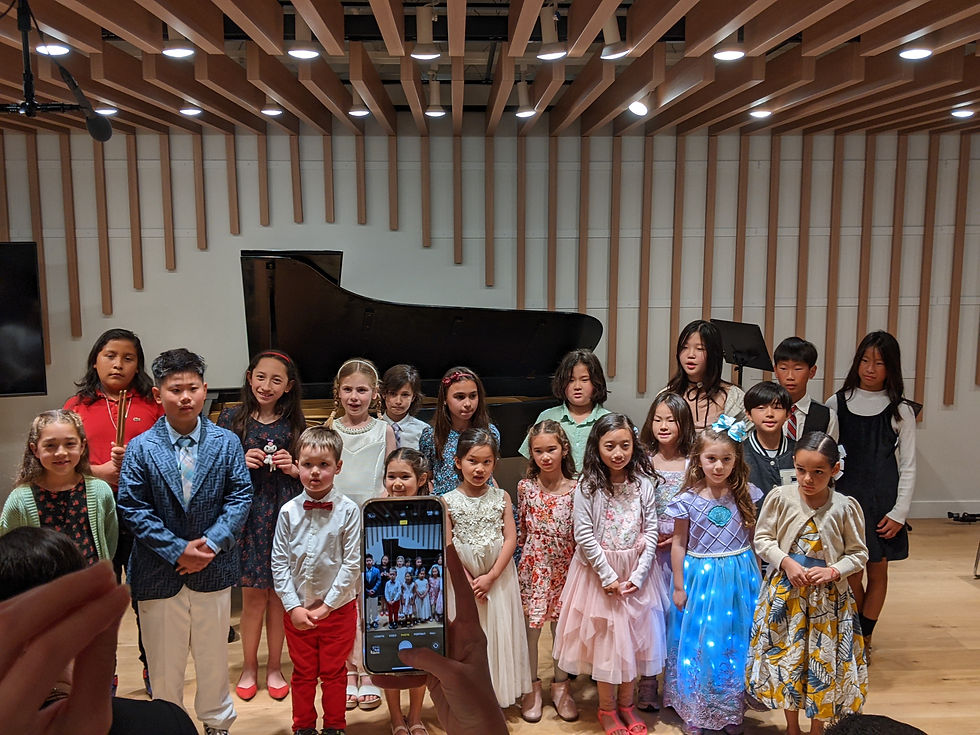
At Symphony 9, students perform for one another, cheer each other on, and learn side by side with teachers who guide them one-on-one. Families fill the room at every master class and recital.

Questions parents ask
What age should my child start music lessons?
It depends on the instrument. At Symphony 9, children can start as young as 3 in Little Maestros, our group music class, and art lessons also begin at age 3. Private piano lessons start at age 6 (Piano Lessons), and private string lessons at age 7 (String Lessons). Not sure if your child is ready? Call us and we'll suggest the right starting point.
Are music lessons worth it if my child won't become a professional musician?
Yes. Most students never become professional musicians, and that was never the main point. The habits described above, practicing with purpose, working through frustration, finding calm and thinking creatively, carry into schoolwork, sports and careers. Music and art also give children something they can enjoy for the rest of their lives.
How much should my child practice?
Consistency matters more than length. For young beginners, a short, focused session most days is a good start, building up as pieces get longer and harder. Ask your teacher for a weekly plan so practice time has a clear goal.
Where can I find music and art lessons near me in Lake Forest?
Symphony 9 School is at 23708 El Toro Road Suite A, Lake Forest, CA 92630, and serves families across South Orange County. We teach piano, strings, voice, woodwinds, guitar and drums, ensembles, music theory and art, for ages 3 to adult. Explore all programs below or call (949) 614-0556.
It's never too early, or too late, to begin.
Symphony 9 School offers music and art lessons for ages 3 to adult, taught by highly qualified teachers who are active performers and artists.
Call (949) 614-0556, email Admin@Symphony9School.com, or visit us at 23708 El Toro Road Suite A, Lake Forest, CA 92630.
Follow the music
Explore Our Programs
Piano Lessons · String Lessons · Guitar & Drum Lessons · Voice Lessons · Woodwind Lessons · Ensemble Lessons · Music Theory · Art Lessons
References
Bowen, D. H., & Kisida, B. (2019). Investigating causal effects of arts education experiences: Experimental evidence from Houston's Arts Access Initiative. Houston Education Research Consortium.
Ericsson, K. A., Krampe, R. T., & Tesch-Römer, C. (1993). The role of deliberate practice in the acquisition of expert performance. Psychological Review.
Fancourt, D., & Finn, S. (2019). What is the evidence on the role of the arts in improving health and well-being? A scoping review. World Health Organization.
Habibi, A., et al. (2016). Neural correlates of accelerated auditory processing in children engaged in music training. USC Brain and Creativity Institute.
Hille, A., & Schupp, J. (2015). How learning a musical instrument affects the development of skills. Economics of Education Review, 44, 56–82.
Kaimal, G., Ray, K., & Muniz, J. (2016). Reduction of cortisol levels and participants' responses following art making. Art Therapy, 33(2), 74–80.
Centers for Disease Control and Prevention (2024). Youth Risk Behavior Survey, United States, 2023. MMWR.
Sekiyama, K., et al. Four-year follow-up of older adults' musical instrument training. Imaging Neuroscience.
World Economic Forum (2025). The Future of Jobs Report 2025.


Comments