Why Perform in a Recital? A Few Minutes on Stage, Confidence for Life

Updated: 3 days ago

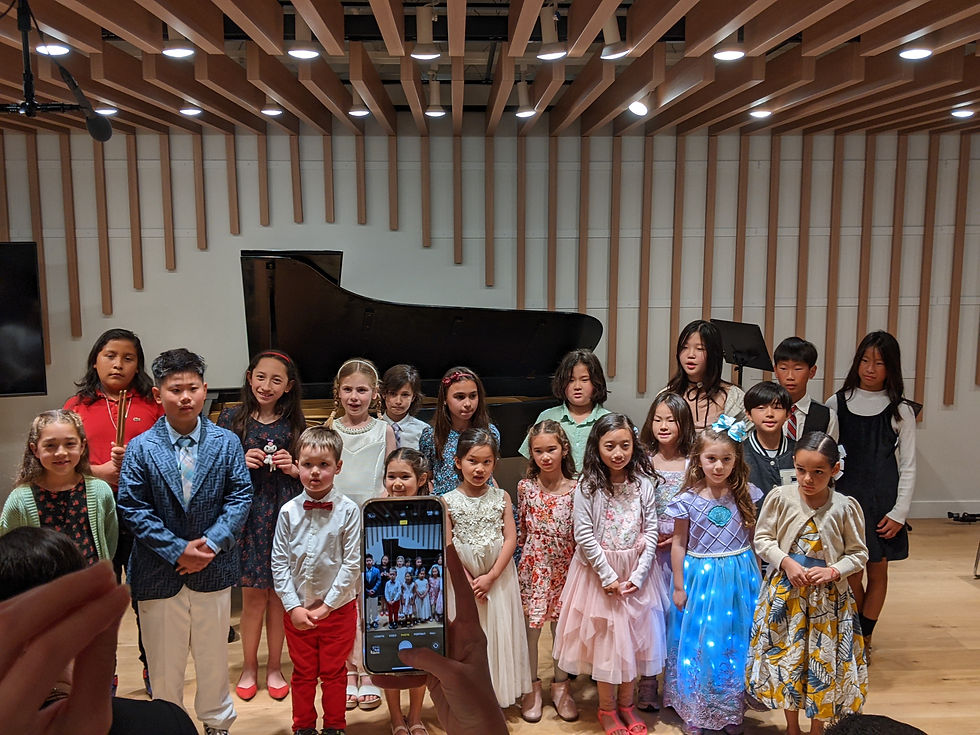
A recital is more than a concert. It gives every student a goal to work toward, a safe stage to practice courage, and a room full of people cheering them on. Symphony 9 School holds recitals each spring and winter, with separate sessions grouped by age, so every student performs alongside peers at a similar stage. Here is what the research says.
By the numbers
No. 1 In one study, a student's belief in their own ability was the strongest predictor of music exam success. | 90% Of studies found specific, challenging goals led to better performance. |
28.7% Of American adults say they're afraid of public speaking. | 61% Of employers call leadership and social influence a core skill. |
A few minutes on stage can build confidence for life.
01 Confidence that carries over

Walking out, taking a breath and playing for a room full of people is a big moment for a young musician. When it goes well, and with good preparation it usually does, students leave the stage with proof they can do hard things in front of others. That belief shows up again at school presentations, auditions and job interviews.
The data: In a study of young musicians taking graded performance exams, self-efficacy, a student's belief in their own ability to succeed, was the most important predictor of how well they scored. Successful performance experiences are one of the main ways that belief is built.
Source: McPherson & McCormick, Psychology of Music (2006)
02 A goal worth practicing for

“Practice more” is hard to stick with. “Be ready to play this piece at the spring recital” is a goal a child can see and work toward. A recital date turns everyday practice into purpose, and students learn how to plan, polish and finish something.
The data: A major review of goal-setting research found that 90% of laboratory and field studies showed specific, challenging goals led to higher performance than easy goals or no goals at all.
Source: Locke, Shaw, Saari & Latham, Psychological Bulletin (1981)
03 Courage, practiced in a safe place

Butterflies before a performance are normal, even for professionals. A recital is a friendly room where students learn what to do with those nerves: breathe, focus on the music, keep going after a slip. Every recital makes the next stage, whether it's a class presentation or a job interview, feel a little less scary.
Why it matters: In the 2023 Chapman University Survey of American Fears, 28.7% of adults said they were afraid or very afraid of public speaking. Students who perform regularly get years of practice standing up in front of an audience before it ever counts.
Source: Chapman University Survey of American Fears, Wave 9 (2023)
04 Stage presence and teamwork

Recitals teach the skills that make people stand out: walking on with poise, bowing, introducing yourself, and in duets, bands and ensembles, listening closely and staying in sync with others. Students also learn to be a great audience, cheering for friends and recognizing their hard work.
The data: In the World Economic Forum's survey of over 1,000 employers across 55 economies, 61% named leadership and social influence a core workforce skill, and 67% named resilience, flexibility and agility.
Source: World Economic Forum, Future of Jobs Report 2025
Every recital is a celebration

Each session is grouped by age, so students perform alongside their peers. Teachers perform too. Families fill the seats, and every performer leaves with applause, a certificate and a few high fives.

Your stage is waiting.
Every Symphony 9 student is welcome to perform. Ask your teacher about our next recital, or book your first lesson to get started.
Call (949) 614-0556, email Admin@Symphony9School.com, or visit us at 23708 El Toro Road Suite A, Lake Forest, CA 92630.
See our recitals
Find Your Instrument
Piano Lessons · String Lessons · Guitar & Drum Lessons · Voice Lessons · Woodwind Lessons · Ensemble Lessons
References
McPherson, G. E., & McCormick, J. (2006). Self-efficacy and music performance. Psychology of Music, 34(3), 322–336.
Locke, E. A., Shaw, K. N., Saari, L. M., & Latham, G. P. (1981). Goal setting and task performance: 1969–1980. Psychological Bulletin, 90(1), 125–152.
Chapman University (2023). The Chapman University Survey of American Fears, Wave 9.
World Economic Forum (2025). The Future of Jobs Report 2025.


Comments